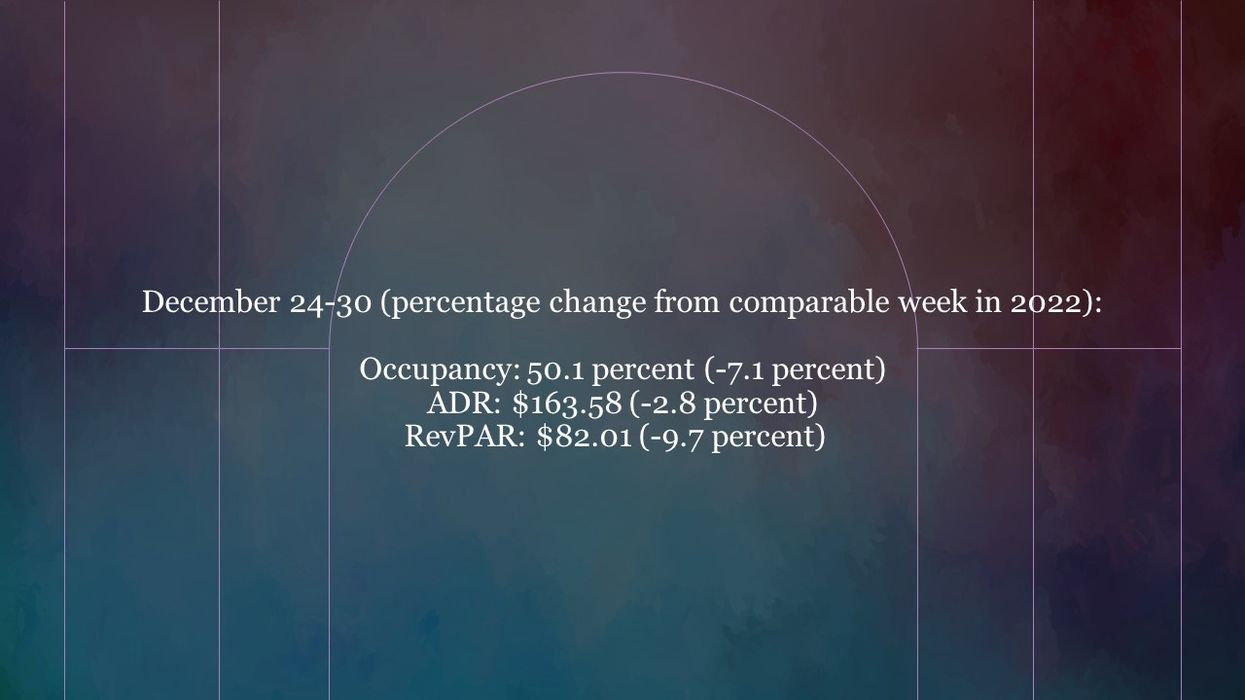

U.S. HOTEL PERFORMANCE increased compared to the prior week, but year-over-year comparisons were unfavorable due to the conclusion of the comparable week from 2022 (Dec. 25 to 31), which included New Year's Eve, according to CoStar. Key performance metrics, including occupancy, ADR, and RevPAR, all saw increases compared to the previous week.
Occupancy rose to 50.1 percent for the week ending Dec. 30, up from the previous week's 43.9 percent but reflecting a year-over-year decrease of 7.1 percent. ADR declined to $163.58, compared to the prior week's $131.97, marking a 2.8 percent decrease from the previous year. RevPAR increased to $82.1, compared to the prior week's $57.9, indicating a 9.7 percent drop from the corresponding period in 2022.
Among the top 25 markets, Miami experienced the largest year-over-year increase in occupancy, up 3.9 percent to 79.6 percent. The market's performance was influenced by the Capital One Orange Bowl and New Year's Eve weekend.
Anaheim recorded the highest gains in ADR, increasing by 11.9 percent to $219.71, and RevPAR rose by 12.5 percent to $160.25. The steepest RevPAR declines occurred in Las Vegas, down 28.3 percent to $112.79, and Nashville, down 27 percent to $80.19.